
How Much Does a Home Renovation Architect Cost?
The question everyone wants answered, and why it's more complicated than you think
You're planning a home renovation. You've done some research, maybe gotten a contractor's ballpark price, and now you're wondering: what will it actually cost to hire an architect?
It's a question we get asked often at Studio Z and answering it honestly means resisting the urge to hand you a number right now. Any architect who hands you a firm price before asking a single question about your home, your goals, or your timeline should raise a red flag.
There's a more important question that actually determines whether hiring an architect is worth it: what does it cost you if you get this wrong? A contractor installs a beam without the support it needs. A layout gets built that never quite fits how your family actually lives. A renovation solves this year's problem in a way that makes next year's more expensive. We’ve got real examples of all three, below.
In this article, we'll walk through how architects typically charge, what actually drives your cost up or down, what a fee should include, and, because it's the part that matters most, what it costs to skip this step or get it wrong.
Understanding how architects charge for home renovations
There are four fee structures you'll typically run into: fixed fee, hourly, percentage of construction cost, and per square foot. None of them is better than the others on its own. What matters is whether the structure fits your project, and whether you understand what it includes.
A fixed or flat fee sets a single price for a clearly defined scope. It gives you predictability, but it depends on the scope holding steady; if it shifts significantly partway through, expect the fee to be revisited.
Hourly billing charges for time actually spent. It tends to work well for smaller projects, one-off consultations, or situations where the scope isn't yet fully defined, for example, a design consultation, or help working through a permit issue.
Percentage of construction cost ties the architect's fee to your project's budget, so the fee scales with the size and complexity of the work.
Per-square-foot pricing bases the fee on the size of the space being renovated. It’s easy to compare on paper, but it’s not typically how architects charge. You’ll see it more often from draftspeople, who tend to revise drawings based on your instructions rather than partner with you to design a home that truly fits your needs over time. And for renovations, square footage alone doesn’t capture how complicated the existing conditions are, which makes it a rougher measure than for new construction.
Studio Z typically charges a combination of hourly rates and fixed fees. We're intentionally not publishing Studio Z's specific rates here because a number pulled from a blog post can't really tell you what your project will cost. The actual cost depends on your home, your goals, and the scope you decide on after a real conversation. What we can tell you is how to think about where your project is likely to land, which is the most helpful place to start.
“As soon as something is built, changing it becomes much more complicated. Our role is to help our clients understand which decisions really need to be made early, so changes stay manageable and don't snowball once construction starts.”
– Dawn Zuber, architect and founder of Studio Z Architecture

What factors drive architectural costs up or down?
No two projects are alike, and the factors below are what tend to move yours relative to others you might be comparing.
Project complexity. A straightforward addition with simple geometry and standard materials costs less to design than a whole-home renovation with structural changes, custom details, and multiple consultants involved. The broader the project scope, the more design work, coordination, and documentation it requires.
Existing conditions. Renovating an older home, especially one with surprises behind the walls, typically takes more documentation time and more creative problem-solving than working with a newer structure. At Studio Z, we take the time to understand your existing home thoroughly before we propose anything new.
Level of service. There's a meaningful difference between an architect who hands you a set of drawings and one who stays involved through construction: answering contractor questions, reviewing submittals, visiting the site to make sure the design intent is actually being built. Full-service involvement costs more, but it also protects your investment at every stage.
Structural and engineering requirements. Depending on your project's structural needs (removing load-bearing walls, adding on, making complex roof changes), a structural engineer may need to be brought in alongside your architect. Their fees are typically separate from architectural fees, so it's worth asking up front whether engineering is included or billed additionally.
Decision-making efficiency. This one's entirely in your hands: projects where clients are decisive and well-prepared tend to move faster and cost less. Projects with a lot of scope changes, revisits, or uncertainty tend to expand. At Studio Z, we guide you through a structured process designed to help you make confident decisions early, which benefits everyone.
Your location. Architectural fees in major metropolitan areas tend to run higher than in smaller markets. If you're comparing proposals from multiple firms, it's worth keeping location in mind for context.
What's included in an architect's fee?
This is where homeowners often get tripped up comparing proposals. A lower fee isn't automatically the better deal: it depends entirely on what's included.
A full scope of architectural services for a renovation typically moves through several phases: early sketches and concept exploration, developed design, and construction documents (the detailed drawings your contractor and permit office need). Along the way, your architect makes sure the design meets local codes and zoning requirements, coordinates with any engineers or consultants, and manages the project from first sketch through final inspection.
Full-service architecture, where your architect stays engaged through construction, adds a real layer of coordination and oversight. Your architect is there to catch problems before they become expensive mistakes, answer questions that come up in the field, and make sure what gets built actually matches what was designed. In that role, your architect also acts as your advocate on site, looking out for your interests and the integrity of the design as construction unfolds. That ongoing project management is one of the most underappreciated parts of what architects do.
“I really enjoy getting to know people, how they're living, how they want to live, and helping them bring that vision to life. A lot of the value of an architect is the problems that never happen because we thought things through before they became costly surprises.”
– Dawn Zuber, architect and founder of Studio Z Architecture
What it actually costs to get this wrong
It can feel counterintuitive to spend money on design services when you're already managing a large construction budget. But skipping an architect, or hiring the wrong one, tends to cost you later, just in ways that are harder to see coming.
Errors caught too late, or not caught at all. More than once, we have seen contractors install steel beams with a steel column supporting one end and a cluster of wood studs holding up the other: studs that simply aren't engineered to carry that kind of load. Without an architect on site to catch it, that client could have ended up with mysterious settling–or even a failure–for years with no idea why. On another project, one of Studio Z's project managers caught it when a contractor skipped the required framing around a large window opening, and let the contractor know before siding went on. In older homes, the surprises can go even deeper: it's not unusual to open a ceiling and find a bathroom held up by far less than it should be, because a plumber cut through structural supports at some point.
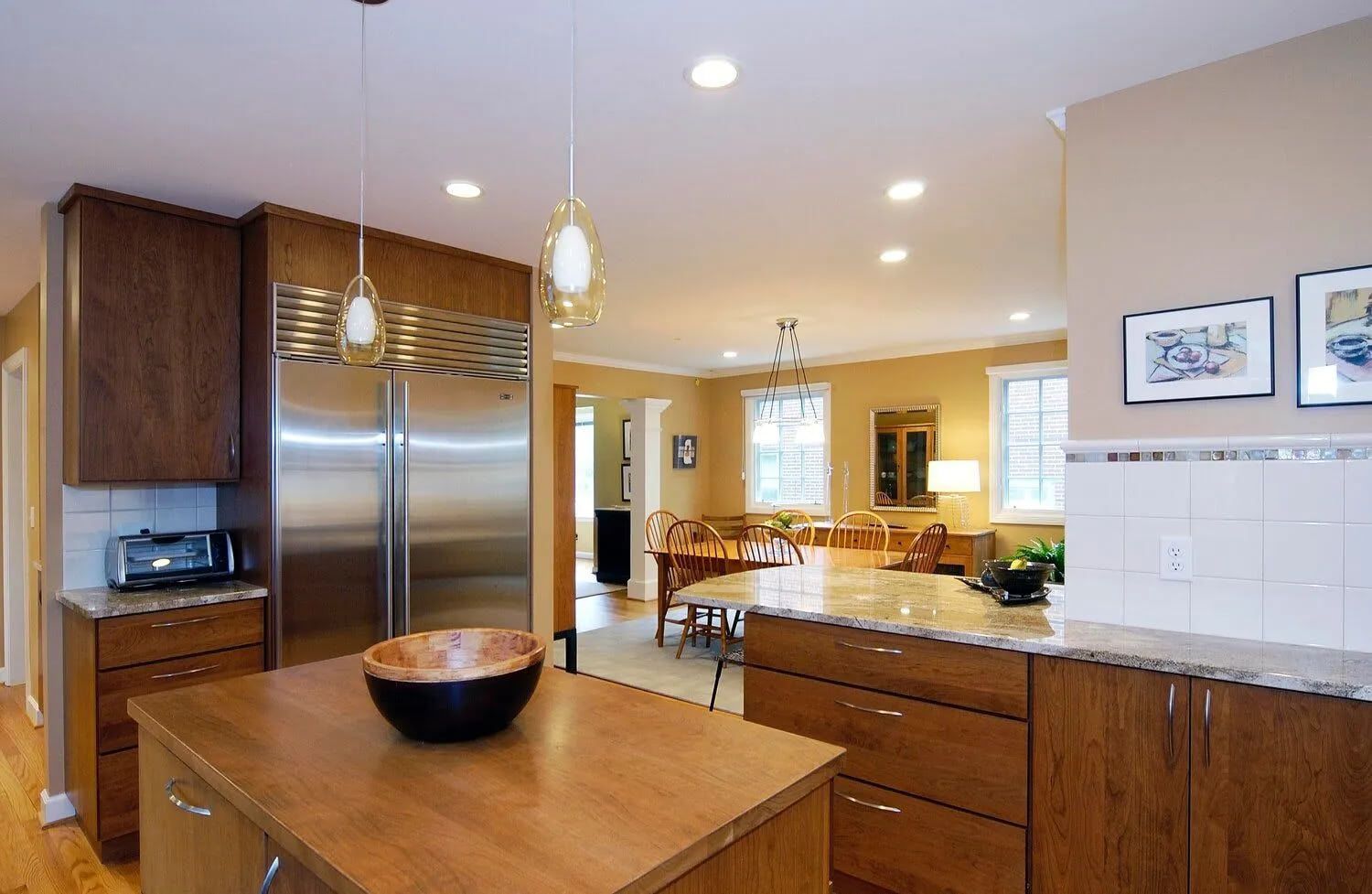
A design that doesn't actually fit your life. We were recently hired by a client who came to Studio Z after working with someone who called himself an architect but wasn't. It showed in the drawings: dimensions were off and the layout created a large, undifferentiated space in the center of the home that didn't work for how the family actually lived. Dawn started over, asking the right questions about how they moved through their days and how they wanted the spaces to relate to each other, and redesigned around their real life instead of a generic open floor plan. That client is now living in their redesigned home and is very happy with how it turned out.
Permit and code complications. Every renovation has to comply with local codes, and in many municipalities those requirements are more nuanced than homeowners expect, especially once square footage is being added or structural work is involved. An experienced architect anticipates these issues, designs around them from the start, and brings in a structural engineer when the work requires it, rather than discovering the complication mid-project.
A plan that boxes out your future. Studio Z regularly works with clients on a master plan: a big-picture view of what the home can become over the next decade, before deciding what to do first. The goal is to make sure solving today's problem doesn't make a future goal more expensive or impossible. Without that master planning, it's easy to spend money on a renovation you'll partially have to undo or redo later.
What to ask when comparing architectural proposals
When you're evaluating architects for your renovation, the fee is just one piece of the picture. Here are questions worth asking every firm:
- What is included in your fee, and what would be billed additionally?
- Will you be involved during construction, or does your service end at drawings?
- How do you handle changes to scope, and how are those changes priced?
- How do you communicate with clients throughout the project?
- Can you walk me through a project similar to mine?
- The answers will tell you as much as the number at the bottom of the proposal.
A note on value vs. cost
At Studio Z, we design for the way you actually want to live, not for a hypothetical future buyer, not to check industry trend boxes, but for you. That starts with questions most contractors never think to ask: how do you move through your home in the morning? Where does the light matter most to you? What would make you relax every time you walk through the front door?
“As architects, we don't have a crystal ball, so it's impossible to predict which features will still feel fresh in 10 years. What we can do is design spaces that feel completely right for the way you live today, and build in flexibility for how your needs might evolve.”
– Dawn Zuber, architect and founder of Studio Z Architecture
That level of attention to your life, your home, and your goals is what an architectural fee actually pays for, beyond drawings, permits, and construction documents. A plan for a home that works for you, delivered with precision from concept through construction.
Let's talk about your project
Every project at Studio Z starts with a conversation, not a quote. We want to understand your home, your goals, and your budget before we propose anything. That's how we can give you an honest sense of what's possible and what it will actually take.
If you're thinking about a renovation and want to know what it would look like to work with us, we'd love to hear from you.
Schedule a consultation to get started.
Frequently asked questions
How much does it cost to hire an architect for a home renovation?
It depends on your project, and that's not a dodge: it's the honest answer. Architects typically charge as a percentage of construction cost, an hourly rate, a fixed fee, or a per-square-foot rate (or a combination of more than one of those!), and where you land depends on your project's complexity, scope, and how you make decisions. The most reliable way to get an actual number is to talk with a firm about your specific renovation.
Does it cost more to hire an architect for a renovation versus a new build?
Renovations can cost more because they involve additional layers of work new construction doesn't. Before any design work begins, your architect has to carefully measure and understand your home's existing structure, then solve the puzzle of integrating new work with the old. That complexity, along with coordinating local codes and often bringing in a structural engineer, can add to the cost.
What's included in an architectural fee?
It varies by firm and proposal, so always ask if the proposal isn’t clear. At minimum, most fees include early sketches, schematic design, design development, and construction documents. Full-service architecture also includes contract administration, meaning your architect stays engaged throughout the build to answer questions, review work, and protect the design intent.
Can I save money by skipping the architect and going straight to a contractor?
You can skip hiring an architect, but that option comes with real tradeoffs. Without an architect, you lose someone who understands the full project scope, catches structural issues before they become expensive, makes sure the design meets local codes, coordinates with a structural engineer when needed, and acts as your advocate during the construction process. For major renovations, the cost of skipping professional design often exceeds the fee itself.
Does Studio Z Architecture handle both the design and construction phases?
Yes. Studio Z offers full-service architectural services, staying involved through construction rather than stopping at the drawing phase. We coordinate with your contractor and any engineers or consultants from the beginning, which leads to better communication, fewer surprises, and a result that actually reflects the design.
Studio Z Architecture is a residential architecture and interior design firm based in Plymouth, Michigan, specializing in major home renovations, additions, and new custom homes. Learn more at studiozarch.com.